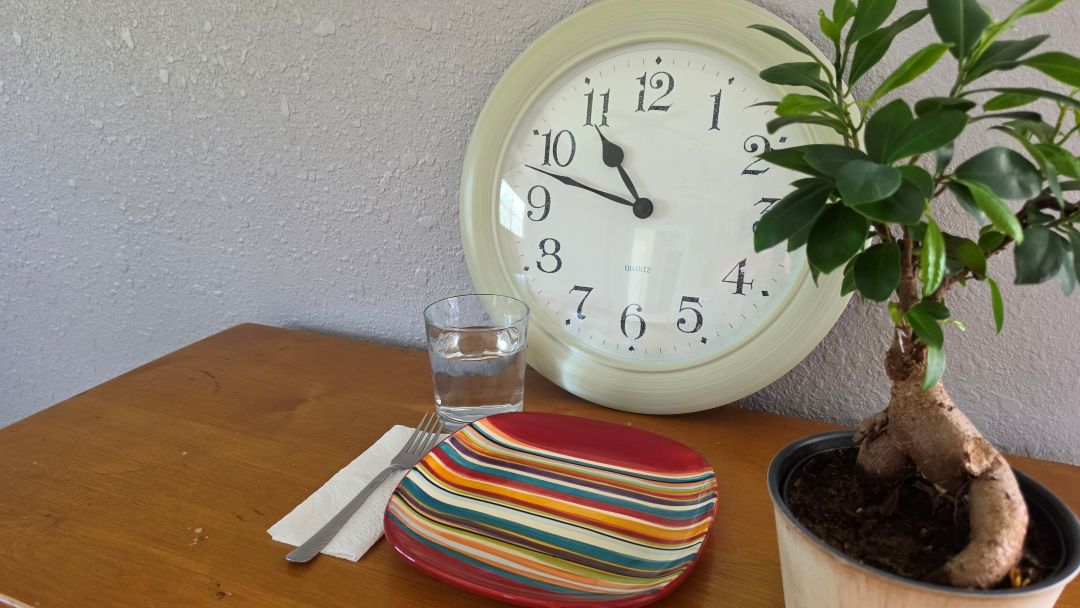

I Keep Coming Back to the Idea of Fasting
Give me a healthy meal and I’ll happily eat it. Put a bowl of cherries, a plate of cookies, or some fresh fruit and nuts within reach and there’s a good chance I’ll keep snacking long after I needed to stop. Add the fact that my wife is part Italian and feeding people is part of her love language, and you’ll understand why fasting becomes even more challenging.
I’ve completed a few longer fasts over the years, mostly trying to understand it as a spiritual practice, but it’s been a long time. These days, it’s more common for me to go 12 to 18 hours without eating than it is to go several days. Sometimes I simply wait until later in the afternoon for my first meal.
What surprises me is how often I feel better when I do.
Not weak. Not deprived. Just better.
My mind often feels clearer. My internal plumbing feels less crowded. Since I already tend to have a slower-moving digestive system, giving my body more time to deal with what I’ve already eaten seems to help. I simply feel less stuffed.
That observation is what led me to start paying more attention to the science of fasting.
One of the most interesting discoveries in recent decades involves a process called autophagy. The word literally means “self-eating,” but the process is less dramatic than it sounds. When food is scarce, cells begin breaking down and recycling worn-out components. It’s one of the body’s built-in cleanup and maintenance systems. Researchers are still learning exactly how fasting affects autophagy in humans, but the discovery was important enough to earn a Nobel Prize and has opened an entirely new area of research into aging and health.
Scientists have also learned that periods without food allow the body to shift between different fuel sources. Instead of relying entirely on incoming calories, the body can begin drawing more heavily on stored energy. Many people report improved mental clarity during this transition, something I’ve experienced myself from time to time.
Of course, reading about fasting and actually fasting are two different things.
The body likes habits.
The kitchen is full of food.
Life includes family meals, celebrations, snacks offered by people we love, and all sorts of social situations built around eating. Sometimes I think I’m going to skip a meal, only to have my wife walk into the room carrying lunch for both of us. At that point, the science of fasting suddenly has to compete with an Italian wife offering food.
The food usually wins.
But the more I learn, the more I wonder if our modern habit of eating from morning until bedtime is unusual. For most of human history, food wasn’t constantly available. Our bodies likely evolved expecting periods of abundance and periods of scarcity. Feast and fast. Eat and rest. Activity and recovery.
Perhaps the body wasn’t designed to be constantly full.
I’ve also noticed something else. Hunger is rarely as urgent as it first appears. If I delay eating for a little while, the feeling often passes. Sometimes what I interpreted as hunger turns out to be boredom, habit, or simply wanting something to do. I’ve spent enough time around food to know that not every craving is a genuine need.
None of this means everyone should begin extended fasts. There are medical conditions, medications, and individual circumstances that can make fasting inappropriate. And I’m certainly not writing this as someone who has mastered the practice.
I’m writing as someone who is becoming increasingly convinced that there is wisdom in occasionally giving the body a break.
The older I get, the more I’m amazed by how much of health comes from supporting processes that were already built into us.
The body knows how to heal wounds.
It knows how to build bone.
It knows how to repair damaged tissue.
It knows how to fight infections.
It knows how to adapt to stress, recover from exertion, and maintain a level of balance that scientists are still trying to fully understand.
Yet we often make the job harder than it needs to be.
We stay up too late.
We move too little.
We spend too little time outdoors.
We eat too much food, too often, and much of it barely resembles the food our grandparents would have recognized.
Fasting interests me because it seems to follow the same pattern as many other healthy habits. It isn’t necessarily about doing more. It’s about creating enough space for something beneficial to happen.
Sometimes health comes from adding the right things.
Sometimes it comes from getting out of the way.
I’m still learning about fasting. I still enjoy good meals with my family. I still find it easier to talk about fasting than to actually do it.
But the more I learn about how the body works, the more fasting makes sense to me. And who knows? Maybe one of these days I’ll finally work up the courage to try a longer fast and see what happens.