

Language Is a Thin Pipeline
Why Some of the Most Important Things in Life Are So Hard to Put Into Words
I was listening to a conversation between Peter Diamandis, Salim Ismail, and Ray Kurzweil when a phrase caught my attention. Salim reminded Ray of something he had once said during a late-night discussion about consciousness: “Language is a really thin pipe to discuss concepts as rich as that.”
That phrase stuck with me.
The older I get, the more I notice how much of life seems too large for words.
I’ve stood on mountain tops, climbed tall trees and poked my head up through the canopy, watched storms roll through canyon walls, held newborn children, buried loved ones, laughed until I couldn’t breathe, and wrestled quietly with questions about God, consciousness, and what it means to be human.
Somehow, all of it feels bigger than the language available to describe it.
Not because language is broken—but because it was never meant to carry that much.
The world we live in below the canopy
We name things.
We organize things.
We talk about schedules, groceries, work, bills, weather, and plans.
Language works beautifully here. It keeps life moving. It helps us coordinate, explain, and navigate the ordinary details of living.
But it is all happening below the canopy.
We are moving through a dense, tangled world of small details, using words to label each twig as we pass.
And for most of life, that works just fine.
The moment we see more than words can hold
We poke our heads above the topmost leaves and suddenly realize there is more going on than we can easily describe.
We stand on a mountain peak and see the world stretch out in ways that feel almost impossible to contain.
We watch a storm move through a canyon like something alive.
We sit quietly beside someone we love and feel something so deep and simple that explanation feels unnecessary—and insufficient at the same time.
We pray, or sit in silence, and become aware of something larger than ourselves, something that does not fit neatly into language at all.
And in those moments, something subtle happens.
Our vocabulary doesn’t fail—it simply runs out of altitude.
Language is a tool built for the ground; it gasps for air at the summit of true wonder.
A mountain I still can’t fully explain
I expected a simple climb and a simple moment.
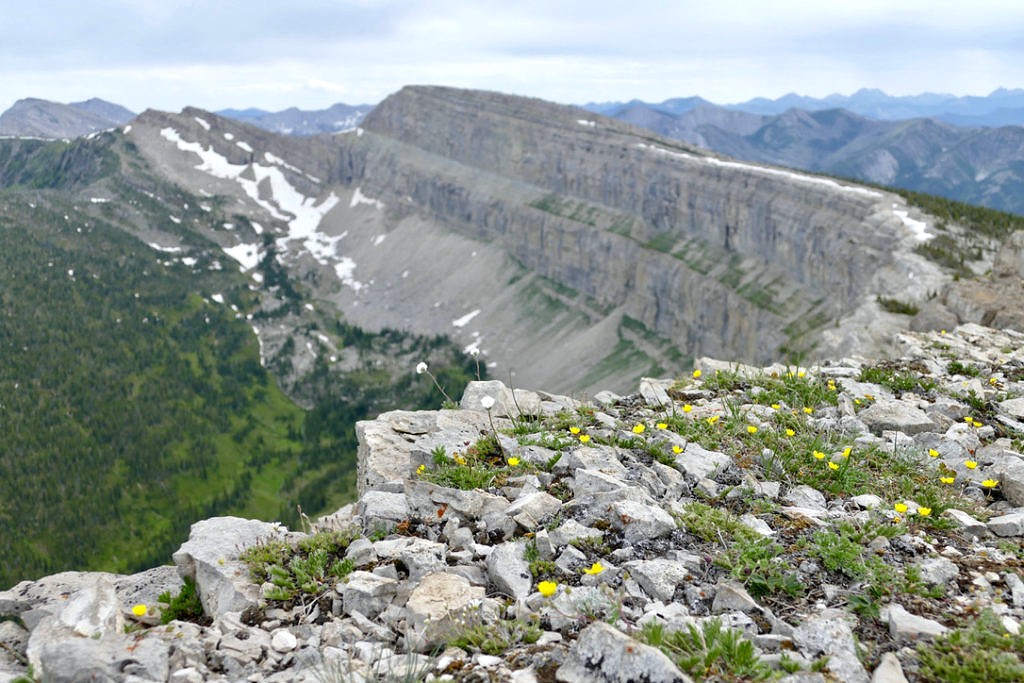
Instead, I found myself on a broad, slanted mountain top that felt like a football field suspended in the sky.
When I approached the edge to look down, a hawk suddenly lifted from somewhere below and startled me so badly I nearly lost my footing.
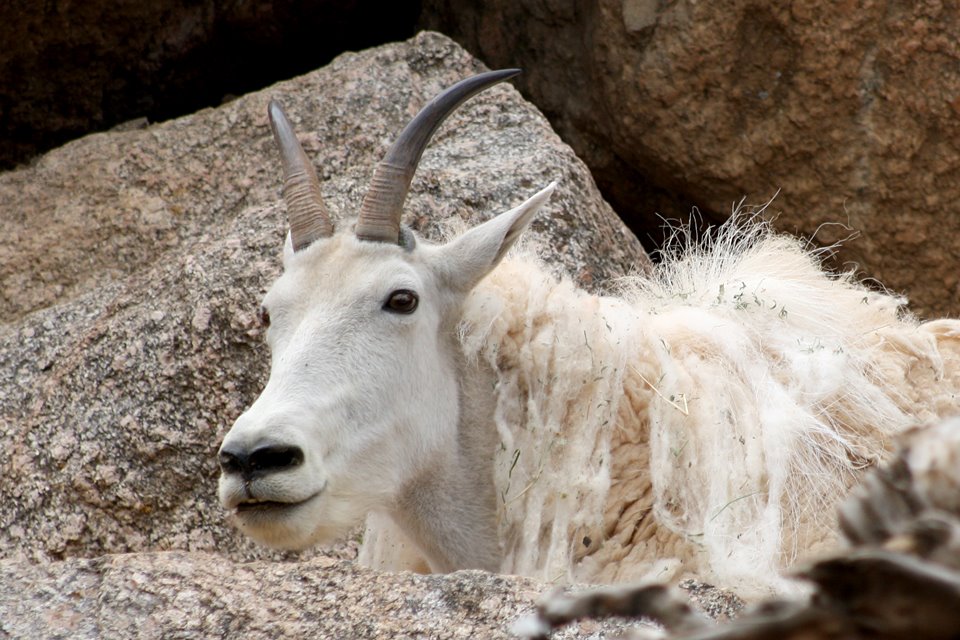
My cousin watched from far below and later told me the mountain goat had likely seen me long before I ever arrived.
I stood there for a long time, just taking it in.
There is no adequate way to describe what it feels like to stand in a place like that—high above everything familiar, looking out over layers of mountains fading into distance.
It wasn’t just beautiful.
It was overwhelming.
Then I saw it.
A storm was moving toward me through the peaks.
Fast.
Wind. Rain. Lightning.
Coming straight through the canyon system in my direction.
Suddenly, awe and danger were sitting side by side.
So I ran.
Not metaphorically.
I ran.
I covered ground as fast as I could, staying far from the edge, until I finally reached the tree line and what felt like safety.
The storm hit hard—wind, rain, thunder rolling through the mountains—and then moved on.
Even now, years later, I can tell the story.
But I cannot give you the experience.
I can only point toward it.
Even our closest words miss sometimes
But it happens even in the closest relationships.
My wife knows me so well that sometimes it feels like she can finish my thoughts.
And yet, at other times, she completely misreads me—and I her.
We are not failing at love.
We are simply encountering the limits of expression inside shared life.
Language compresses too much, too quickly.
And sometimes what comes out on the other side is not what was meant at all.
Even simple messages can become tangled. A long text arrives with multiple thoughts and questions woven together, and instead of responding poorly, I sometimes find myself defaulting to a thumbs-up emoji—acknowledging the message, but unsure how to safely enter it without missing something important.
It’s almost humorous.
But it also reveals something deeper.
We are constantly trying to fit complex inner worlds into small external signals.
When words are there, but not quite there
There is something clearly there she wants to say.
You can see it in her expression, her determination, the effort.
But the words don’t arrive in time—or sometimes don’t arrive at all.
The thought exists, but it cannot fully make the journey into language.
Watching that struggle has been a quiet reminder that there may be far more happening inside each of us than we are able to express outwardly.
Different worlds, different meanings
When I moved from the Chicago area to the Florida panhandle, it felt like stepping into a different way of thinking about life altogether.
What I had always assumed was “common sense” didn’t always feel common here.
And what made sense here didn’t always match what I had grown up believing was obvious.
It wasn’t simply disagreement.
It was difference of experience.
Different environments shape different assumptions.
Different lives produce different meanings for the same words.
We often assume we are arguing about facts when we are really translating between worlds.
The thinness of language—and the depth of life
Language is essential. It is beautiful. It is one of the greatest tools we have.
But it is also thin.
It allows us to move through the surface of life with remarkable efficiency, yet it struggles when we reach the deeper layers—where meaning, mystery, love, and awe live.
Maybe that is part of why God never quite fits in the box I try to make.
Every attempt to define feels incomplete.
Not because God is absent from language—but because God is larger than it.
And perhaps that is true of many of the most important things in life.
Living with what cannot be fully said
Because it means that no matter how much we speak, write, or explain, life always remains larger than our descriptions of it.
There will always be something beyond the words.
Something still to experience.
Something still to wonder at.
Something still to live.
And maybe that is not a problem to solve.
Maybe it is part of the design.
A quiet kind of gratitude
Not everything can be explained.
Not everything can be contained.
Not everything can be reduced into language and passed from one mind to another without loss.
And yet we still try.
We still point.
We still tell stories.
We still climb mountains and come back down trying to describe what we saw.
We still sit with each other and attempt to be understood.
We still reach for words, even knowing they are not enough.
And somehow, that effort itself feels meaningful.
Because even if language is a thin pipeline, it is still the one we have.
And through it, something of the human experience still makes its way across.
Not perfectly.
But enough.
The more I think about it, the more I realize:
We are not just communicating information.
We are trying to share awe.
We are trying to share life itself.
And what an amazing mystery it is that we can even come close.